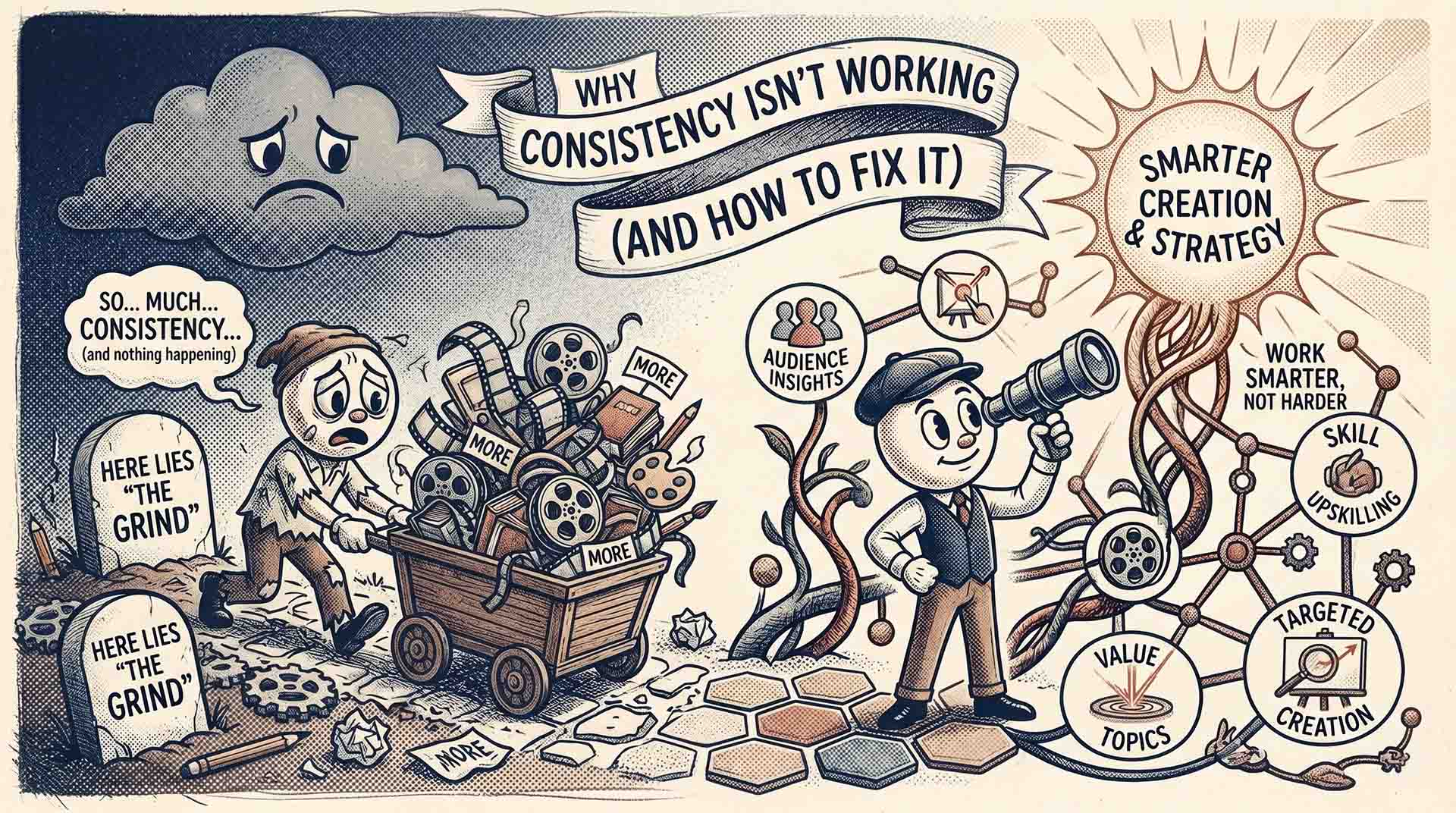
Why Consistency Isn't Working (And How to Fix It)
The quiet system behind content that grows.
A few years ago, I tried everything. I used the tips and tricks. I optimized the titles. I made things look visually beautiful, which came naturally because of my background as a filmmaker and photographer. I put in the hours.
And still, growth felt unpredictable and slow.
It was only when I started designing marketing and brand strategies for clients that I was forced to look past the surface. I had to look at what truly mattered.
This entry comes from that shift. It is about turning creative frustration into analytical clarity, and turning blind consistency into something that actually compounds.
If you are stuck under 1,000 views, let's get one thing straight. You are not talentless. You are just data-less.
The Lottery Ticket Fallacy
We have all been told that consistency is the magic key. So you post daily, you show up, and you sweat over the edit. And yet, the view count does not move.
Here is the uncomfortable truth. Consistency did not fail because it does not work. It failed because you lack a system.
The hardest work in modern media is not the creating. It is the studying.
Most people skip the analysis entirely. They post, check their views, feel defeated, and post again, simply hoping for a different result. That is not consistency. That is buying a lottery ticket and praying it hits.
Seth Godin often talks about finding the tension. The tension here is that your creative ego wants to move straight to the next project, but your business mind needs to look at the cold, hard metrics of the last one.
The Five-Step Loop
To fix this, you have to transition from an emotional creator to a disciplined strategist. It happens in five distinct phases.
1. Observe
You need to learn pattern recognition. Stop consuming content passively and start studying what already works for creators in your niche. Look at their top twenty pieces of content and dissect them like an editor. Why did the hook stop your scroll? How did they move you from curiosity to clarity? Where did the visual energy shift? What was the actual payoff?
You do not need to be entirely original, but you are not copying either. Most viral frameworks have been done a thousand times before. The market is just waiting to see your version of them.
2. Apply
Take those frameworks and test them. Try their storytelling structures and try their pacing, but inject your own perspective, your voice, and your specific visual style.
3. Let the Audience Teach
Your analytics are a mirror, so listen to them. A week after posting, look at the retention graph. Did they drop off in the first three seconds? Your hook failed. Is the skip rate high in the middle? Your pacing dragged. High saves but low comments? You provided massive informational value, but you did not spark a conversation.
4. Test Like a Scientist
This is where discipline separates the amateurs from the pros. Change only one or two variables at a time. Test a new hook style on an old topic, or try a new editing rhythm on a familiar concept. Log the results.
5. Double Down
When a post outperforms your baseline average, do not just celebrate and move on. Replicate it. Double down on the exact structure that worked.
This is where the compound effect begins. It is like a snowball rolling down an alpine hill. At first, it looks like nothing is happening. You see 200 views, then 250. But then the lessons stack, and suddenly you hit 700, then 1,800, then 7,000.
Eventually, you hit your first 10k views. It was not luck. It was built quietly, behind the scenes and away from the spotlight.
Three Mistakes Screwing Up Your Momentum
Mistake 1: Quitting before momentum becomes visible. Imagine pushing a heavy vintage car. At first, it barely moves a centimeter, and you are straining every single muscle. But once it gets rolling, inertia takes over. Most creators walk away while the car is still heavy.
Mistake 2: Expecting certainty before failure. I hear it all the time from creatives who say they do not know their exact style yet, or they are not sure if a concept will land. Confidence is an afternoon guest. It arrives after you have done the work, not before. You figure it out by doing.
Mistake 3: Repetition without awareness. Repeating the same action over and over without analyzing the data is useless. That is like taking the same exam every week but refusing to check which answers you got wrong.
The Speed of Data
You have probably heard famous internet gurus telling you to post five times a day. The magic of that advice is not about pleasing a mythical algorithm. It is simply about data speed. If you post five times a day, you collect patterns five times faster. You learn what fails in a single weekend rather than over a whole month.
But let's be real. Most creators moving at that volume have an army of editors and writers behind them. For a solo practitioner, it is a direct ticket to burnout.
The goal should not be high volume. It should be high-speed learning. You can post at a sustainable pace, as long as your observation is hyper-focused. The old bouche-à-oreille, or word of mouth, does not require you to pollute the internet with noise. It requires you to be remarkably helpful to one person at a time.
A Note on Creative Ego
The algorithm has a beautiful way of humbling us. It does not care how many hours you spent in DaVinci Resolve, and it does not care how proud you are of the color grade. It only responds to human attention and delivered value.
Blaming bad luck or a platform update feels easier than accepting that your content did not hold someone's interest. Drop the defensive stance. Treat the analytics like a mirror instead of an enemy. If you stay curious instead of hurt, the data will show you exactly how to build a brand that people can trust.
You do not need to be entirely ready. You just need to begin.
Have an amazing day, and thanks for your attention. With love, Santi.